Apartments and houses meet community heating
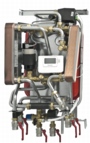
The combi ‘boiler’ that can be connected to a community-heating system — Alfa Laval’s City community-heating substation.
Alfa Laval’s City community-heating substation is designed to provide on-demand heating and hot water for apartments and single-family houses connected to a community-heating network. There are two versions to provide direct or indirect connection to the network. The directed version is suited to low-pressure community-heating systems and provides heating direct from the main circuit to the apartment. Domestic hot water is heated indirectly via a high-efficiency compact heat exchanger. In the indirect version, heat exchangers provide indirect heating of DHW and space heating. For ease of installation, wiring is factory installed and tested, and plumbing connections are located to enable top or bottom connection. It can be installed on a wall or in a cupboard and is said to require less space than traditional substations or individual domestic boilers. It can be connected to underfloor heating systems through control equipment designed for this purposes. The City substation provides fully automatic individual temperature settings for heating and hot water. Once the desired temperature has been set, the system automatically regulates itself. The energy supplier or building manager can monitor the energy drawn by a substation using a system that records the flow of heat from a central source.
For more information on this story, click here: Jun, 08 181

Related links:


modbs tv logo

Lighting the way

Halesowen College has set a sustainability example for higher education institutions by installing smart lighting as part of its latest environmental initiative, making up to 85% energy savings compared to the previous system.

BESA updates HIU Test Standard

The Building Engineering Services Association (BESA) has announced an important update to its UK Heat Interface Unit (HIU) Test Standard, further strengthening performance benchmarks and supporting the sector’s readiness for incoming heat network regulation.