


Understanding the route to truly open control systems
Ron Bernstein reflects on what he perceives as the open-systems myth and provides a perspective on marketplace confusion in the quest for truly open systems.The building controls market is on the verge of dramatic change — not just a step along the path to eventuality, but a monumental shift in the way the industry has been operating for the past 100 years! This monumental shift is open systems. The concept is simple; you buy a product from one manufacturer and plug it in to a product from another manufacturer in the same system — and, without any ‘engineering’, it works. This article look at the building-controls market and explores various technologies and systems that are at the cornerstone of the changes occurring in the market. It looks at system differences such as open versus closed, and proprietary versus public domain. It also examines the various options available to see where the trends are. Setting the stage People tend to discuss open systems based on the assumption that the fundamental choice is between open and proprietary technologies. This is not the case; the real choice is between open and closed systems. The opposite of open is closed, and the opposite of proprietary is public domain. Open systems are becoming the norm in the commercial and industrial space. In the not-too-distant future, open systems will be a requirement in homes as well. It is safe to say that few, if any, building owners believe that the future of the buildings market lies with closed, proprietary systems. Open systems — unlike closed systems —deliver:• greater choices in manufacturers, suppliers, and integrators;
• initial installation and life-cycle cost savings;
• increased business opportunities;
• enhanced system performance;
• more-marketable properties. Systems based on public-domain specifications are also being positioned as open, but suffer from a free-market business model that fails to ensure the survival of the intent of the specification. In other words, companies adopting such public-domain systems for their use have no business imperative to implement the system in an open way. The reality is that public-domain systems lend themselves to the delivery of closed systems provided under an ‘open’ label. It is a great way to take advantage of the movement to open systems in the buildings market; too bad it does not do the building owners any good. New options As the industry shifts from the traditional, closed, single-vendor systems of the past, new options are being revealed. There are three stops along the path to open systems. • Traditional home run wired systems, where the sensors and actuators are considered dumb devices and there is a central ‘controller’ responsible for the entire operation of the system.
• Tiered ‘islands of control’, where individual sub-systems can communicate to other islands through a higher-level communication protocol.
• Flat, interoperable systems, where each device is autonomous, has its own ‘intelligence’ and the ability to communicate with its peers. No one device is responsible for any other device, and devices from different manufacturers communicate in a peer-to-peer, plug-and-play method. To take full advantage of open systems, we must embrace flat systems. For this industry to catch up with the computer and other industries, we must demand flexibility, options, and choices.
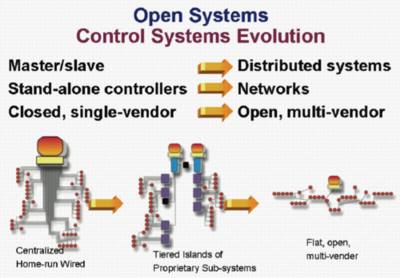 |
Fig. 1: The evolution of control system toward open system follows three steps. |
• Subsystem level: multi-vendor, tiered subsystems.
• Device level: multi-vendor, flat, device systems.
Traditional system-level building-automation systems have the following characteristics.
• Entire system supplied by one vendor. • Sole source of products.
• Sole source of integrators. • Limited options for expansion.
• Sole source for service contracts. • Proprietary technology and products.
• Closed system. Today’s manufacturers and integrators no longer spend time arguing that a closed system is better for the customer. They understand that a closed system is not better. This is why so many manufacturers of building-automation systems are entering the open-systems market with new products. Tiered islands An intermediate step along the path to open systems is the tiered islands of proprietary subsystems,with the following characteristics. • Multiple subsystem suppliers.
• Closed subsystems connected through closed gateways.
• No device-level interoperability.
• Sole source for subsystem service contracts.
• Multiple subsystem control protocols. • Limited cross-system functionality.
Problems still remain with tiered subsystems. For example, building owners and integrators must rely on a single source of products, services, and integrators. One vendor’s product cannot be replaced with another’s product, and an entire subsystem might have to be removed to allow for expansion. Also, there is limited device-level interoperability. On typical tiered system where two different companies’ subsystems are part of a bigger system, at the higher level the systems are configured to communicate through programmed gateways. But you cannot take a product of vendor A and put it on the network of vendor B. There is no guarantee that the devices will communicate, since they may be using completely different protocols. Better than the intermediate step are the open, device-level interoperable systems. Systems in this category offer an open and interoperable approach down to the device level. Characteristics of this type of system include the following. • Multiple device-level suppliers.
• Freedom to choose best-of-breed suppliers. • Multiple system-level integrators.
• Not locked in to a single source for service contracts.
• Multiple subsystems can be integrated into one common architecture.
• Interoperability down to the device level.
• More flexible, more open, more cost effective systems. Independent industry associations have created and implemented the guidelines and certification testing to ensure interoperability among devices on a control network. Equipment selection more closely resembles the integration in the PC market, where suppliers of hard drives, motherboards and monitors can each provide products to an integrator who delivers the system. The integrators can choose which product they want to use and swap products at any time. Plug-and-play
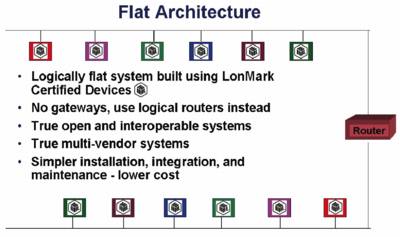 |
Fig. 2: In this typical open architecture, each device on the network can communicate in a peer-to-peer fashion with any other device. These devices can be from HVAC, lighting, energy metering, process control, security, access etc., and each can logically share information on the same network without the need for gateways, supervisory controllers or closed subsystems. |