

Towards energy-efficient cooling and humidification
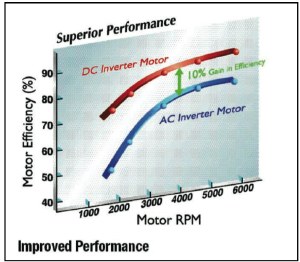
How the efficiency of a DC inverter motor compares with an AC motor over a range of operating speeds.

Fig. 1: The replacement of chillers with 10-year-old screw compressors with Hitachi Samurai chillers has considerably reduced energy consumption.
The combination of R410A, DC inverters and improved micro-processor controls continue to reduce energy consumption. Losses at high speed are reduced by digital control slowing down inverter-driven compressors and fans — delivering enhanced performance over standard AC motor-driven systems by up to as much as 10%. Coefficients of performance of more than 4.4 can be achieved, achieving the A class rating of the EC Directive standard labelling system. Significant developments in chiller technology over recent years have brought into the market place machines designed for optimising the individual components that make up the system — such as condenser coils with slit fins and inner grooved tubes, selection of the most favourable heat exchangers to provide thermal exchange without impacting on pressure drops, highly efficient brazed plate evaporators and the use of screw compressors with modulating capacity control. Options for free cooling, partial and full heat recovery support the selection of equipment to maximise the energy saving benefits. Part-load performance Particularly advantageous is improved part-load performance. Chillers are normally selected to cool against the peak load that will occur in the building, with a safety factor. These loads occur on only a few days each year, so a chiller will be running at part load for 95% of the year, if not more. Compressors such as those used in Hitachi chillers are renowned for their part-load efficiency, and a chiller operating at 20°C ambient and at 70% capacity will have a COP almost double that at 35°C and 100% capacity — from 3 at full load to 6 at the part load. This effectively halves the power input, so running costs are also reduced. To further boost efficiency, compressors have modulating capacity slide valves, so they only use the energy required to meet the cooling demand, which also improves control of the system to give further energy savings. Project The consideration of lifetime costs reaping the benefits of modulating control compressors with high part load performances is illustrated by a recent project where Axair Climate demonstrated the considerable savings of Hitachi Samurai chillers over six existing, 10-year-old chillers with screw compressors. Three of the original chillers were replaced, with the other old machines retained as back up. Since the installation was completed, the new chillers have easily satisfied the demand without resorting to any of the original machines. Aware of the superb part-load efficiencies, the client’s energy manager scheduled chiller operation to take advantage of this, while monitoring the electrical current and instantaneous COPs of each machine. The positions of valves in air-handling units are also monitored and in low-load conditions the chiller flow temperatures are increased to further improve energy use. These variables are logged and referenced against degree-day data to minimise the energy use of the chillers. All design assumptions and theoretical claims have been justified when comparing the total energy costs over for consecutive years (Fig. 1). For chillers up to 250 kW, the introduction of multiple scroll compressors shows benefits in energy consumption. When combined with heat-pump technology, they can provide heating and cooling, as well as domestic hot water. Further developments are expected to increase the capacity range of products using this expertise. Humidity control Relative humidity is of equal importance in maintaining a comfortable working environment. Low relative humidity occurs mainly in the winter, at a typical indoor temperature of 21°C the relative humidity of the air, if not humidified, can be below 30% RH.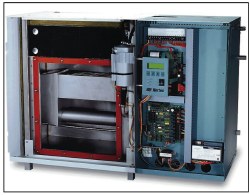
Although they have a high capital cost, the energy savings achieved with gas-fired steam humidifiers have typical payback times of 18 months or less
One of the most obvious effects of dry air effect is electrostatic shocks, which occur below 40% RH. To eliminate these nasty sparks, the solution is to increase the relative humidity to the correct level. There are also many symptoms caused by dry air; skin dryness, dry throat and nasal stuffiness, susceptibility to respiratory problems and tired eyes are a few we are all familiar with. If we humidify a building correctly to a comfortable relative humidity of 50%, the temperature of a heated building can often be reduced by a couple of degrees. This reduction in temperature can result in large savings in energy consumption and produce a far more efficient building — exactly what we should all be striving to achieve. Traditionally electrode boiler humidifiers are the most common type installed in the UK. With the focus on energy efficiency and the control of carbon emissions, a shift away from the traditional system installed can offer many benefits. Gas-fired steam humidifiers attract a considerably higher capital cost than either electrode boiler or resistive steam humidifiers, but work out far cheaper in the long run. The Condair GS gas-fired humidifier, for example, has a typical payback times within 18 months — often less. Cold-water atomising and evaporative units are very cost effective, especially if their inherent cooling effect can be used within the physchrometrics of the system. Modern adiabatic systems are designed to maximise humidification performance and minimise water wastage. Like gas-fired humidifiers the payback period is often within 18 months.